Is ChatGPT safe? What it keeps and who can read it
Is ChatGPT safe? What ChatGPT, Claude and Gemini keep, what never to paste, and how stolen logins and spying extensions expose your whole chat history.
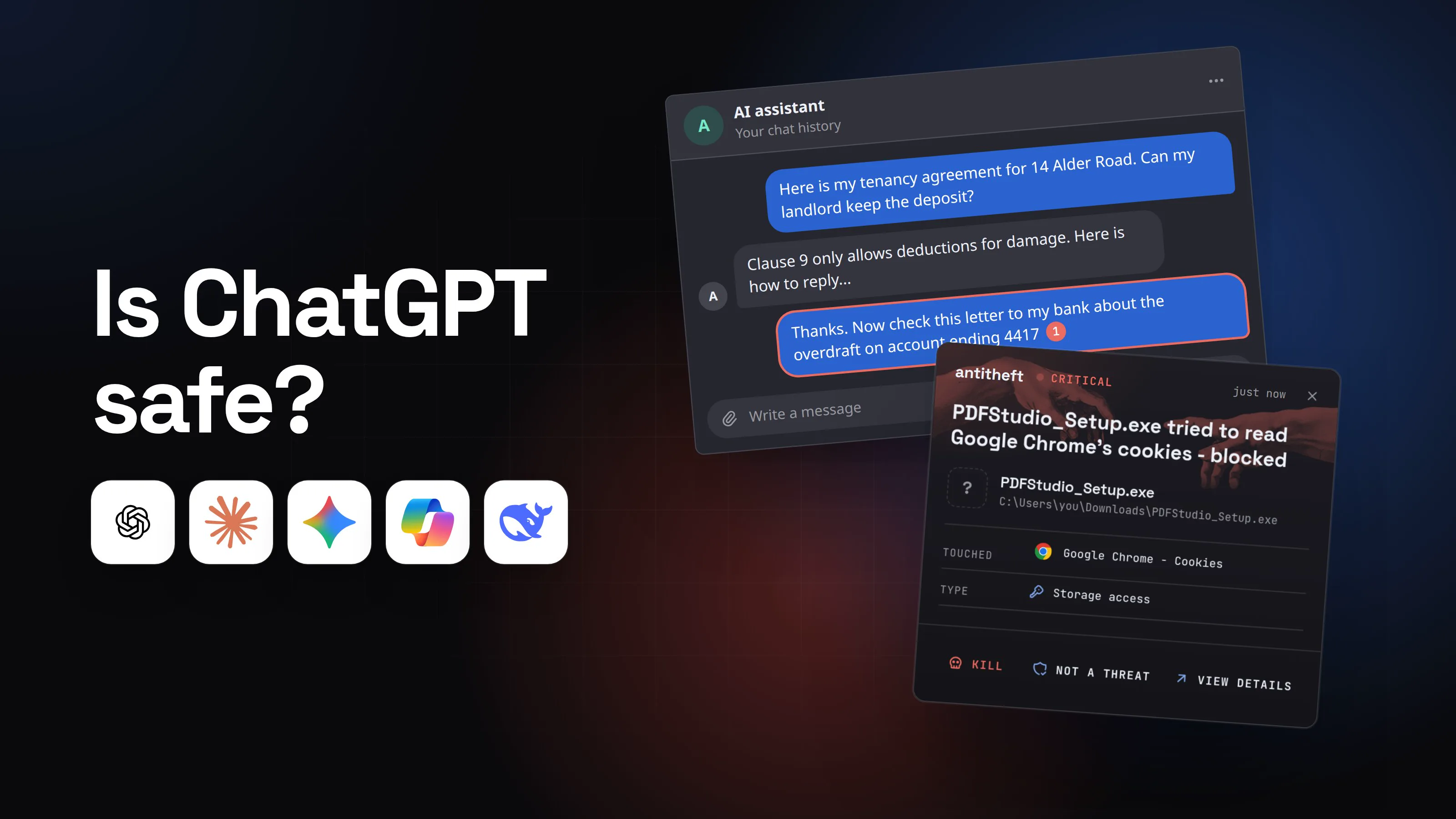
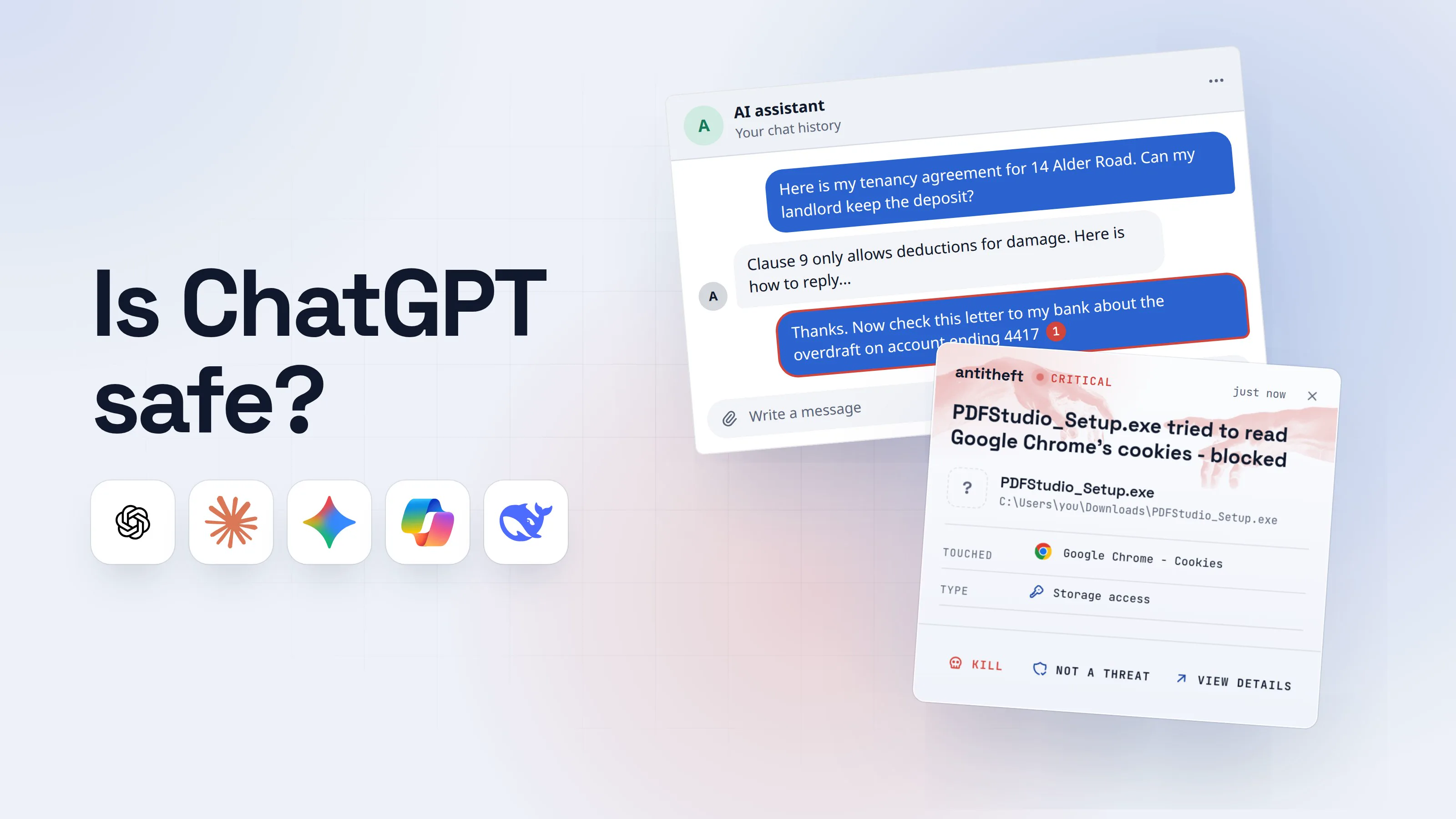
Is ChatGPT safe? For everyday use, yes. ChatGPT, Claude and Gemini are run by large companies, and attacks on their own servers are rare. The real risks sit on your side of the screen, and most people never think about them.
Your chat history is a diary you never meant to keep. Tax questions, health worries, a contract, a fight with a landlord, a draft to your bank. Whoever opens your account reads all of it, and in 2026 the usual way in is not guessing your password. It is a copied login taken from your own browser.
This guide covers what each service keeps, what never to paste, the three ways other people end up reading your chats, and a checklist that closes them.
What happens to what you type into ChatGPT?
Everything you type is saved to your account's history and, unless you turn it off, can be used to train future models. Each of the big three handles it a little differently, according to their own help pages:
| ChatGPT | Claude | Gemini | |
|---|---|---|---|
| Used for training? | Yes, unless you turn off "Improve the model for everyone" | Only if you allow it in the Model improvement setting | Yes while Keep Activity is on |
| Private mode | Temporary Chat: not in history, not trained on, kept up to 30 days | Incognito: never used to improve Claude | Temporary chat: not trained on, kept 72 hours |
| Read by people? | Can be reviewed, for example to check for abuse | Chats flagged for a safety review | A subset reviewed by human reviewers, kept up to three years |
Two lines are worth remembering. Anthropic keeps chats you allow for training in a de-identified form for up to five years. Google says it plainly: "Please don't enter confidential information that you wouldn't want a reviewer to see."
Deleting a chat removes it from your history at once. Anthropic says deleted chats leave its back-end storage within 30 days.
For power usersWhere the switches are
- ChatGPT: profile icon > Settings > Data controls > "Improve the model for everyone". Temporary Chat is the toggle at the top of a new chat.
- Claude: Settings > Privacy, the model improvement setting. Incognito is offered when you start a new chat.
- Gemini: the Gemini Apps Activity page in your Google account (myactivity.google.com/product/gemini) > Keep Activity. Gemini also offers temporary chats.
- Work and school accounts follow their organisation's settings, which can differ from these consumer defaults. Ask your admin before pasting company data at all.
Is it safe to put personal information into ChatGPT?
Ordinary personal details are fine; anything that works as a key is not. A question about your rash or your rent is low risk. A password, a seed phrase or a passport number sitting in your history becomes a gift to whoever reads it next, whether that is a thief in your account, an extension, or a link you forgot you shared.
Never paste these into any AI chat:
- Passwords, PINs and two-factor codes. No assistant needs them to help you.
- Seed phrases and wallet private keys. Anyone who reads them owns your crypto, permanently.
- ID numbers: passport, national ID, social security, driving licence.
- Full card and bank details, including screenshots of statements.
- API keys, tokens and passwords inside code or config files you ask it to debug. Replace them with
xxxxfirst. - Other people's data: client files, patient notes, employee records, anything under an NDA.
When you need help with a real document, remove the names and numbers first. The answer is just as useful with "Client A" and "1234".
Can ChatGPT be hacked?
Breaking into OpenAI's own systems to read your chats is rare; breaking into your account is common. In November 2025, OpenAI disclosed that its analytics provider Mixpanel had been breached. Names and email addresses of some API users leaked, and OpenAI said no chats, passwords or API keys were exposed.
Your account is a much easier target. IBM's X-Force team reported that in 2025 more than 300,000 ChatGPT credential sets were advertised on the dark web, driven largely by infostealer malware whose operators added AI services to their shopping lists.
An infostealer does not need your password. It takes the session cookie your browser keeps so you stay logged in. Whoever loads that cookie into their own browser is you: no password prompt, no two-factor code, your whole chat history in the sidebar.
How do ChatGPT accounts get stolen?
Almost always the same way: a stealer runs on your computer and copies the logins your browser keeps. It arrives through the usual routes, and none of them has anything to do with AI.
Here is how it ends up in your chats.
- 1Your AI assistant knows more about you than most people doMonths of questions, documents and drafts, saved to your account.AI assistantYour chat historyHere is my tenancy agreement for 14 Alder Road. Can my landlord keep the deposit?Clause 9 only allows deductions for damage. Here is how to reply...Thanks. Now check this letter to my bank about the overdraft on account ending 44171Write a message
- 1Every chat stays in your history, readable by anyone logged in as you
- 2You install a free app from a search adThe ad looked official. The installer worked. Nothing seemed wrong.PDF Studio Pro SetupPFree full versionDownloaded frompdfstudio-free-download.com1Installing PDF Studio Pro...64%Launch PDF Studio Pro when setup finishesBackNext2
- 1Not the maker's own site: the address came from a search ad
- 2The app really installs. The stealer runs alongside it
PDF Studio ProDrag PDF Studio Pro to Applications
PPDF Studio ProApplications1Downloaded frompdfstudio-free-download.com2- 1The app really installs. The stealer runs alongside it
- 2Not the maker's own site: the address came from a search ad
- dangerIts hidden stealer copies your browser's loginsIn seconds, before the app even finishes installing.
What the stealer takes from your browser
- Your logged-in AI accountsChatGPT, Claude, Gemini: every chat you ever had
- Every saved passwordEmail, bank, shopping, socials
- Your other logged-in sessionsAccounts open without a password or 2FA code
Whoever buys the log reads your chats as you. No password, no code.
With antitheft
With antitheft, your browser's logins stay in your browser
- Caught the moment it reaches for your cookies or saved passwords
- Refused before a single login is copied
- Even a brand-new stealer no antivirus has seen yet
- Touched
 Google Chrome - Cookies
- Type
- Storage access
- Touched
- Google Chrome - Cookies
- Type
- Storage access
Keep stealers out of your passwords and wallets
- Guards passwords, browser logins and wallets
- Stops malware your antivirus misses
- On Windows, macOS and Linux
The stealer was after your browser's stored logins, and your AI accounts live there with everything else. antitheft is built on one rule: only your browser may open your browser's cookies and saved passwords. Anything else is refused, so the stealer leaves with nothing to sell, and nobody gets to scroll through your chats.
For power usersWhy two-factor sign-in does not save a stolen session
Two-factor authentication guards the moment you log in. A session cookie is proof that you already did. Replaying it skips the login page entirely, so the second factor is never asked for. The only cure for a copied session is to end it on the server: "Log out of all devices" in ChatGPT (Settings > Security, up to 30 minutes to take effect), the Active sessions list in Claude (Settings > Account), and the device list in your Google account for Gemini. Do that from a clean device, or a stealer still running will simply copy the new session.
Can browser extensions read my ChatGPT chats?
Yes. Any extension allowed to "read and change data on all websites" can read every chat on your screen, and in 2025 several were caught doing exactly that.
- December 2025, Koi Security: Urban VPN Proxy, a free VPN with Google's "Featured" badge and about 6 million Chrome users, had been capturing prompts and answers from ChatGPT, Claude, Gemini, Copilot, Perplexity, DeepSeek, Grok and Meta AI since an automatic update on July 9, 2025. It collected even with the VPN switched off. The same code sat in seven sister extensions, more than 8 million installs in all, and the data went to an affiliated data broker.
- December 2025, OX Security: two "AI sidebar" extensions with 600,000 and 300,000 users copied full ChatGPT and DeepSeek conversations plus browsing history every 30 minutes. One of them also carried the Featured badge.
Be clear about what helps here. An extension runs inside your browser and reads the page the browser shows it. antitheft guards the browser's stored logins against other programs; it does not police what an extension you installed does inside the browser. This one is a habit: keep few extensions, and remove any you do not use every week.
Are shared ChatGPT links private?
No. A shared link is public: anyone who has it can read the conversation and pass it on. It only feels private because the address is long.
Search engines have picked these pages up more than once. ChatGPT shared conversations turned up in Google results in the summer of 2025. In July 2026, Fortune reported hundreds of shared Claude conversations in Google results, some holding names, addresses and crypto wallet keys. Anthropic's answer: "When someone shares a conversation, they are making that content publicly accessible."
Check what you have shared. In ChatGPT it is Settings > Data controls > Shared links > Manage, where you can delete one link or all of them.
Are ChatGPT apps safe to download?
The real apps are; the copies are not. ChatGPT, Claude and Gemini come from their makers' own sites and the official app stores. "ChatGPT for PC" from an ad, a cracked "Pro" version, or an AI video tool that arrives as a .exe in a zip are a favourite stealer disguise. The full guide is fake AI app malware.
How to make your ChatGPT account safe
Ten minutes of settings closes most of the ways in:
- Two-factor sign-in. ChatGPT: Settings > Security, use an authenticator app or a passkey rather than SMS. Claude and Gemini sign you in through your email or Google account, so lock that account down the same way.
- Review logged-in devices. Log out anything you do not recognise, then use "Log out of all devices" if in doubt.
- Choose your data controls. Turn training off if you prefer, and use Temporary or Incognito chats for anything sensitive.
- Delete shared links you no longer need.
- Audit your browser extensions. Remove VPNs, ad blockers and "AI helpers" you do not truly use, and anything with access to all sites that you cannot explain.
- Clear secrets out of old chats. Search your history for "password", "seed" and your ID number, and delete those chats.
- Install apps only from the maker or the official store. No AI app from an ad, a forum or a "free Pro" link.
What to do if your ChatGPT account was hacked
Signs include chats you did not start, a changed name or settings, or projects and custom GPTs you never made. Act from a device you trust, such as your phone:
- Log out of all devices in ChatGPT's security settings (or Claude's Active sessions). This ends the stolen session.
- Change the password, and the password of the email account behind it.
- Turn on two-factor sign-in with an authenticator app or passkey.
- Assume the computer is infected if you never shared your password. A stolen session usually means a stealer ran on it, so every other saved login was taken too: follow what to do after an infostealer.
- Rotate anything you ever pasted into a chat: API keys, passwords, wallet keys. Move crypto to a new wallet if a seed phrase was ever in your history.
- Delete shared links and sensitive chats, and tell your employer if work data was in the account.
For the bigger picture of where AI tools help and where they put you at risk, read is AI safe to use.
Questions people ask
Is Claude safe to use?
Yes, in the same way ChatGPT is: the app itself is not the danger. Claude asks whether your chats may be used to improve its models, Incognito chats are never used for that, and deleted chats leave Anthropic's servers within 30 days. The risks are the same as with ChatGPT: what you paste, shared links, extensions that read the page, and a stolen login. Claude signs you in through your email or a Google or Apple account, so put two-factor authentication on that account.
Is Gemini safe, and do people at Google read my chats?
Some of them, yes. Google says a subset of Gemini chats is reviewed by human reviewers, and reviewed chats are kept for up to three years. Google's own advice is not to enter anything you would not want a reviewer to see. Turning off Keep Activity, or using a temporary chat, keeps new chats out of training; Google still holds them for 72 hours.
Does ChatGPT sell my data?
OpenAI does not describe selling your conversations. The real exposure is different: chats can be used to train future models unless you turn that off, and anything in your history can be read by whoever gets into your account. A browser extension you installed can also read the page and send it elsewhere, which is how millions of people's AI chats ended up with a data broker in 2025.
Does deleting a chat or using Temporary Chat make it private?
It makes it much more private, but not instant. ChatGPT's Temporary Chats are not saved in your history and are not used for training, but OpenAI keeps them for up to 30 days and may review them for abuse. Deleted Claude chats leave Anthropic's back end within 30 days. Neither helps if an extension or malware read the chat while it was on your screen.
Can someone read my ChatGPT history without my password?
Yes, if they have your session. When malware copies your browser's session cookie for ChatGPT, the thief opens your account as you, without the password and without a two-factor code. That is why "Log out of all devices" matters after any infection: it kills the copied session.
the short version
Yes, ChatGPT is safe to use, and so are Claude and Gemini: the danger is not the app but who else can read your chats. Never paste passwords, seed phrases, ID numbers or client data, turn off training if you prefer, and protect the account like your email: two-factor sign-in, no unknown browser extensions, and "log out of all devices" if your computer was ever infected.
sources
- IBM: 2026 X-Force Threat Intelligence Index, securing identities (300,000+ ChatGPT credential sets advertised in 2025) (Feb 2026)
- IBM Newsroom: IBM 2026 X-Force Threat Index, AI-driven attacks are escalating (Feb 2026)
- The Register: Browser 'privacy' extensions have eye on your AI, log all your chats (Koi Security findings on Urban VPN Proxy and sister extensions) (Dec 2025)
- The Hacker News: Featured Chrome browser extension caught intercepting millions of users' AI chats (Dec 2025)
- OX Security: 900K users compromised, Chrome extensions steal ChatGPT and DeepSeek conversations (Dec 2025)
- Fortune: Users' seemingly private conversations with Anthropic's Claude showed up in Google search results (Jul 2026)
- OpenAI: What to know about a recent Mixpanel security incident (Nov 2025)
- OpenAI Help Center: Data Controls FAQ (training setting, Temporary Chat)
- OpenAI Help Center: ChatGPT shared links FAQ
- OpenAI Help Center: Multi-factor authentication (MFA) and log out of all devices
- Anthropic Privacy Center: Is my data used for model training?
- Anthropic Privacy Center: How long do you store my data?
- Claude Help Center: Managing your active sessions
- Google: Gemini Apps Privacy Hub